

Nigerians Ask: Why Is U.S. Building Its Largest Consulate in Nigeria While Tightening Visa Access?
Nigerians are questioning the strategic logic behind the United States’ decision to build what is expected to become its largest consulate in the world in Lagos, even as Washington continues to tighten visa requirements and restrict routine visa-processing services in Nigeria.
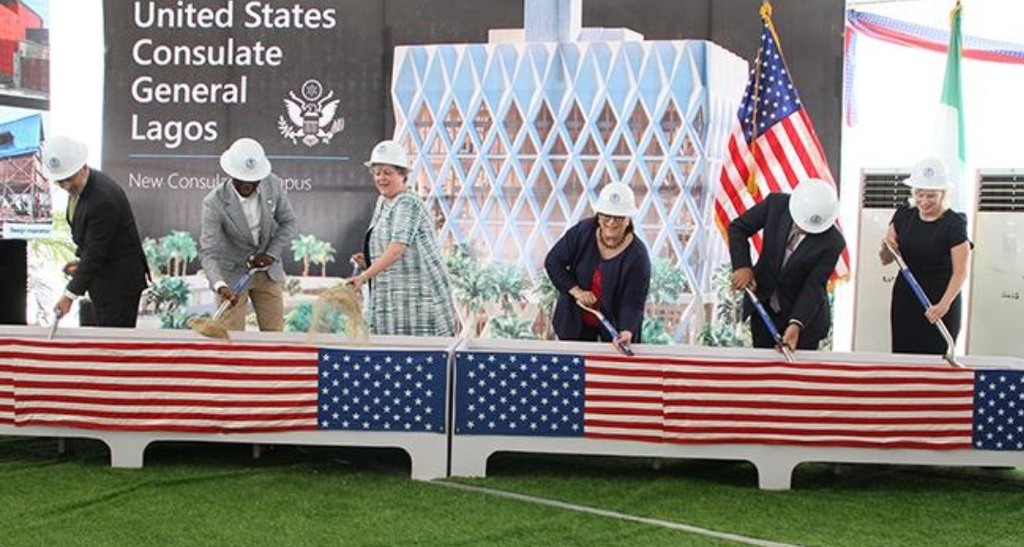
The new U.S. Consulate General is being constructed at Eko Atlantic City on a massive 12.2-acre site and is designed as a 10-storey diplomatic complex. The project has a reported budget of about $567 million and is expected to be completed in 2027.
The scale of the project has attracted public attention because it comes at a time when Nigerians seeking to travel to the United States are facing increasingly stringent visa measures.
From August 1, 2026, routine U.S. visa services in Nigeria were realigned to Lagos, making the U.S. Consulate General in Lagos the country’s designated regional visa hub. Routine visa processing is no longer being offered at the U.S. Embassy in Abuja.
For many Nigerians, the timing has raised a simple but significant question: If the United States is making such a huge long-term investment in Nigeria, why is it simultaneously making access to American visas more difficult?
The question has become even more prominent following Washington’s visa-bond policy.
Nigeria was placed on the U.S. visa-bond programme in January 2026. Under the policy, eligible Nigerian applicants seeking B1/B2 business or tourist visas can be required to post a bond before receiving the visa. The initial amounts were set at $5,000, $10,000 or $15,000, depending on the circumstances of the applicant.
The policy has since become tougher, with Washington announcing a permanent programme under which the possible bond amounts can rise to $10,000, $15,000 or $20,000.
For an ordinary Nigerian applicant, such sums represent a significant financial burden and could place a U.S. visit beyond the reach of many prospective travellers.
Yet, at almost the same time, the United States is investing hundreds of millions of dollars in a new diplomatic complex in Lagos.
The apparent contradiction has triggered questions among Nigerians about what Washington’s long-term strategy for Nigeria really is.
The U.S. government maintains that the Lagos project is about much more than visas. The new facility is designed to strengthen America’s diplomatic presence in Nigeria and support its broader relationship with Africa’s most populous country and one of its largest economies.
Lagos is Nigeria’s commercial and financial centre and plays a major role in trade, investment, technology, innovation and international business. A larger diplomatic facility gives the United States greater capacity to engage with Nigerian authorities, businesses, investors, civil society organisations and other stakeholders.
The consulate will also support a wide range of diplomatic and consular functions beyond visa processing, including assistance to American citizens, political and economic engagement, security cooperation and other U.S.-Nigeria programmes.
This means that the construction of the new facility does not necessarily signal that Washington wants more Nigerians travelling to the United States.
Instead, it could indicate that the United States wants to maintain and deepen its strategic relationship with Nigeria while becoming more selective about who enters American territory.
In simple terms, America may be separating its diplomatic relationship with Nigeria from its immigration policy.
The United States can therefore invest heavily in maintaining its presence in Nigeria while simultaneously introducing tougher measures aimed at controlling immigration, reducing visa overstays and strengthening security screening.
Washington has defended the changes as part of efforts to improve visa operations, strengthen screening and make better use of its consular resources.
But for Nigerians, the contrast remains striking.
On one hand, the United States is constructing a massive new diplomatic facility in Lagos at a cost running into hundreds of millions of dollars. On the other hand, Nigerians seeking to visit the United States are confronting stricter requirements, possible visa bonds and changes to where routine visa services are provided.
The development has consequently sparked a broader conversation about the future of Nigeria-U.S. relations.
Nigeria remains strategically important to Washington because of its population, economy, regional influence, security importance and role in West Africa. The two countries cooperate on issues ranging from security and counterterrorism to trade, investment, education, healthcare and technology.
The new consulate could therefore be viewed as a long-term investment in that relationship rather than an indication of relaxed American immigration policies.
Still, Nigerians are asking whether a stronger American presence on Nigerian soil will eventually translate into easier opportunities for Nigerians to travel, study, work and do business in the United States, or whether the relationship is moving towards deeper government-to-government and business engagement while ordinary travellers face greater restrictions.
For now, Washington’s position appears to be that the two policies serve different objectives.
The massive consulate project is intended to strengthen America’s strategic and diplomatic engagement with Nigeria, while the visa restrictions are aimed at controlling entry into the United States.
But for Nigerians watching both developments unfold at the same time, one question remains particularly striking:
Why is America building bigger in Nigeria while making the journey from Nigeria to America harder?
